By Jim Allen, an Idaho Mobile Notary since 2018. Updated September 2026.
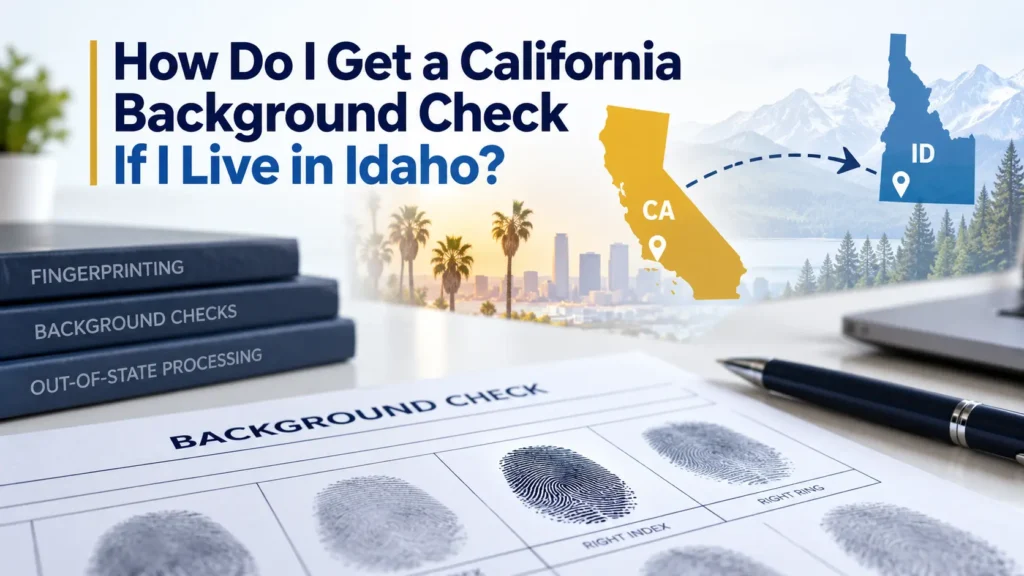
To get a California background check while living in Idaho, you send your fingerprints to the California Department of Justice (DOJ), along with the form your California agency gave you. The official route for anyone outside California is a paper fingerprint card. California’s DOJ says that “applicants fingerprinting outside the State of California cannot use Live Scan” and “must complete a Fingerprint Hard Card (FD-258).” That route works. It’s just slow. There are three ways to get it done, and each one costs you a different amount of time.
I’m Jim Allen. I run Idaho Notary Signing Agent here in the Treasure Valley, and I fingerprint people for a living. A lot of them live in Idaho but need a license from California. Nurses. Contractors. Real estate agents. Teachers. They all ask me the same question, so here’s the straight answer.
What is a California background check?
A California background check is a fingerprint search run by the California DOJ. Your prints get checked against state criminal records. Most license checks also go to the FBI for a national search.
Here’s the part that surprises people. The results don’t come to you. They go straight to the agency that asked for them. That might be a licensing board, a school district, or an employer.
Who needs one?
Mostly people applying for a California license or job. These are the ones I see most often in Idaho:
- Registered nurses and LVNs
- CNAs working through the Department of Public Health
- Pharmacists and pharmacy techs
- Therapists and counselors licensed through the BBS
- Teachers applying for a credential
- Security guards applying for a guard card
- Contractors applying through the CSLB
- Real estate agents and brokers
- Insurance producers
What is Live Scan?
Live Scan is a way to take fingerprints on a glass scanner instead of with ink. The DOJ explains that the operator checks your ID, types in your details, captures your prints, and sends them to the DOJ electronically. No card. No mail. No waiting on a stamp.
What is an FD-258 hard card?
An FD-258 is the old paper card. Your prints are rolled in ink, one finger at a time, into little boxes. Then the card gets mailed to California, and someone there processes it by hand. That hand step is why it takes so much longer.
Why does California care how your prints are taken?
State law pushes hard toward electronic prints. California Penal Code 11077.1 says the DOJ accepts license prints “only if” they’re sent electronically. It allows paper cards when electronic sites aren’t available where you live. That’s the reason people outside California get handed a card.
How do you get a California background check from Idaho?
You get the form from your agency, choose how your prints will be taken, pay the fees, and wait while the agency gets your results. Here’s each step.
Step 1: Get the right form from your agency
Everything starts with paperwork from the agency asking for your check. For Live Scan, that’s the Request for Live Scan Service form (BCIA 8016). It carries the agency’s code number, called an ORI, and the type of license you’re applying for.
Many boards send their own version with the ORI already filled in. Use that one, not a blank copy you found online. If you go the hard-card route, some boards mail you the cards themselves.
Step 2: Pick how your prints get taken
This is the big decision. You’ve got three roads.
Option 1: Travel to California
You can fly or drive to California and walk into any Live Scan site there. Your results come back fast. But you’re paying for a trip, taking time off work, and hoping your appointment is still open when you land.
Option 2: Mail in FD-258 hard cards
This is the DOJ’s default for people outside California. You get your prints rolled in ink, often at a local police or sheriff’s office, and then mail the cards. Here’s what the boards themselves say about the wait:
- The Board of Behavioral Sciences says hard cards take about 6 to 8 weeks.
- The Commission on Teacher Credentialing says its hard-card process takes about 10 to 12 weeks.
- The Contractors State License Board says hard cards can take “three to six months or longer.”
That’s a long time to sit on a job offer.
Option 3: Get scanned in Idaho, submitted from California
This is the road I offer. I come to you here in the Treasure Valley and scan your fingerprints digitally. Our partner company in California then processes your fingerprints through their Live Scan system and submits them to the California DOJ. No ink, no card, and nothing in the mail.
Step 3: Pay the fees
You’ll pay up to three separate fees. The first is the government fee, which pays the DOJ and FBI to run your check. The Department of Real Estate, for example, lists a $49 fingerprint processing fee. For most license checks that’s $32 to the DOJ and $17 to the FBI.
The second is the rolling fee. That goes to whoever takes your prints, and it changes a lot from place to place. The third is your board’s own application fee, which goes straight to the board.
Step 4: Wait for results
With electronic prints, the wait is short. The DOJ says “eighty percent of the electronically submitted fingerprint checks are completed within three business days.”
If your record has a possible match, a person has to review it by hand. That takes longer. The DOJ’s applicant FAQ is clear that it “does not offer an expedited process.” Your board’s review of the rest of your application runs on its own clock too.
Keep your ATI number
When your prints go through Live Scan, you get a 10-digit ATI number on your form. Hang on to it. You’ll need it, plus your date of birth, to check on your status.
What are the benefits of doing it electronically?
The biggest benefit is time. Electronic prints usually come back in days. Hard cards take weeks or months.
Faster answers
For the California checks I handle, the DOJ usually returns results in under five business days, and it can run as long as 10. That count starts when your prints are submitted, not when you book. Compare that to three months waiting on a card.
Fewer do-overs
Clean prints matter. The FBI’s own fingerprint quality guide says electronic capture comes with “built-in quality controls” that help make sure prints are readable before they’re sent. I look at each print on screen before I leave. If one’s smudged, I redo it right there at the table.
Nothing to lose in the mail
A card in the mail can get lost, bent, or stuck in a pile. An electronic submission skips the mailbox completely.
No hunting for an open office
You don’t have to track down a sheriff’s office with open fingerprint hours. I come to your home, office, or workplace in Ada or Canyon County.
What should you watch out for?
Watch for two things: the quality of your prints and using the right form for the right agency.
Bad prints can reset the clock
Prints get rejected for two different reasons. The first is a bad capture, like a rushed roll, a smudge, or poor positioning. If that’s on me, I’ll re-capture your prints at no charge.
The second is ridge quality. Years of manual work, age, some medications, and dry skin can wear ridges down. I’ll work the capture as hard as it can be worked, but I can’t guarantee the state accepts prints from fingers without much ridge left. After two rejections for print quality, the DOJ may switch to a name-based check, and that can take a while.
How to get your hands ready for print day
Most rejected prints come down to skin, not the scanner. The FBI’s guide to recording legible fingerprints spells out what makes prints come out clean, and a lot of it is up to you.
- Wash with soap and water. The FBI says soap and water are the preferred way to clean hands before printing. Dirt and oil blur the ridges.
- Skip the lotion that morning. Lotion still sitting on your skin can smear the image. If your hands are dry or flaky, the FBI’s fix is a small amount of lotion with the extra wiped off, and that’s done right before the scan, not hours earlier.
- Keep your skin from drying out. The FBI’s tip sheet on reducing fingerprint rejects lists hydrating the fingers as a way to get higher-quality images. Our dry Idaho air is rough on hands, so if yours crack, moisturize the nights before your appointment.
- Relax and let me guide your hand. The FBI tells the person taking prints to have you look away, relax, and not try to help. The weight of your finger is usually all the pressure a clear print needs, so pressing down hard only smudges it.
- Tell me about cuts or bandages first. An injured or bandaged finger can’t always be printed. The FBI has a set way to mark those fingers, so let me know before we start.
Worn ridges are the tough one. The FBI notes that some people, “by the nature of their work or age,” have very thin or worn ridges. A trick called “milking the finger,” rubbing down from the palm to the fingertip, can help raise them before the scan.
One check doesn’t cover two agencies
A background check is tied to the agency on your form. If two agencies want your prints, plan on two checks. The Board of Behavioral Sciences puts it simply in its fingerprint FAQ: “the results cannot be shared between agencies.” The same goes for an FBI check. That’s a separate service with its own steps, and you can read about it on my FBI background check page.
Check whether you even need prints
Some people don’t. California’s Department of Insurance says many non-resident insurance producers are exempt if their home state already fingerprinted them. Read your agency’s instructions before you book anything.
How does Idaho Notary Signing Agent help with California background checks?
I come to you and scan your fingerprints digitally here in Idaho. Our partner company in California processes them through their Live Scan system and submits them to the California DOJ. You don’t travel, and nothing gets mailed. I’ve been a notary since 2018, and I have 265 Google reviews with a 5.0 average.
Here’s what a visit looks like:
- You book by call, text, or online.
- I come to you, check your photo ID, and enter your details from your agency’s form.
- I scan your fingerprints digitally and look at each one on screen before I go.
- Our partner company in California processes your prints through their Live Scan system and submits them to the California DOJ.
- Results go to the agency named on your form.
It’s $349 for one person. That covers my drive to you, the capture, the data entry, getting your prints submitted, and government fees up to $75. Two or more people at the same stop pay $299 each, and that’s everyone in the group, not just the second person. If an agency’s fees run past $75, you pay only the difference, and I confirm it with you before anything is submitted.
Bring a valid, unexpired photo ID and the form from your agency. You’ll find the full details, plus a page for each license type, on my California background check page.
FAQ: California background checks from Idaho
Can I do a California Live Scan if I live in Idaho?
The DOJ’s official route for people printed outside California is the FD-258 hard card. I offer a different route: I scan your fingerprints digitally here in Idaho, and our partner company in California processes them through their Live Scan system and submits them to the DOJ.
How long does a California background check take?
Electronic checks usually come back in days. For the checks I handle, the DOJ usually returns results in under five business days, and it can take up to 10, counting from submission. Hard cards often take 6 weeks to several months, depending on the board.
How much does a California background check cost?
The government fee for most license checks is $49: $32 to the DOJ and $17 to the FBI. You also pay a rolling fee to whoever takes your prints, plus your board’s own application fee. With me, it’s $349 for one person, including government fees up to $75, or $299 each for two or more at the same stop.
Will I get a copy of my results?
No. Results go to the agency named on your form, and I never see them either. If you want to see your own California record, the DOJ has a separate record review process for that.
What happens if my fingerprints get rejected?
If the problem is my capture, I’ll re-capture your prints at no charge. If it’s worn ridges from age, work, or dry skin, I can’t guarantee the state will accept them. After two rejections for print quality, the DOJ may run a name-based check instead, which can take longer.
Can I reuse a background check I already did for another agency?
Usually not. Each check is tied to the agency and code number on its form. Use the form your board sends you, and plan on a new check for each agency that asks.
Ready to get your prints headed to California?
Ready to take the next step? Book a time online or call or text me at (208) 826-1210. I’ll come to you and get your prints on their way.
— Jim Allen, Notary Boss