You’ve got a document in Spanish and somebody needs it in English. Certified.
Maybe it’s an immigration attorney. Maybe it’s the Ada County clerk, a school registrar, or the DMV. Whoever it is, they said the same thing:
“We need a certified translation.”
Here’s the short version of what that means and how I handle it.
What I do with Spanish documents
I’m Jim Allen, a Boise-area notary. I don’t translate documents myself. What I do is run the job: I look at your document, get it to a certified Spanish translator, check that the certification is the format your receiving office wants, and hand it back to you finished. One person, one invoice, one phone number if something’s off.
Spanish is the language I see most. In a normal month that’s:
- Mexican birth certificates (actas de nacimiento), marriage certificates, and divorce decrees
- CURP and INE documents, when a filing asks for them
- Records from Guatemala, Honduras, El Salvador, Colombia, Peru, Venezuela, and the rest of Latin America
- School transcripts and diplomas for Boise State, CWI, and the school districts
- Police and background letters (cartas de antecedentes)
- Powers of attorney and estate documents coming from or going to family abroad
English to Spanish works the same way. If you need a Boise document read by a notary in Mexico or a court in Colombia, I’ll get it translated in that direction, and if that country wants a sworn translation instead of a certified one, I’ll tell you before you pay. Sworn Spanish translations are a separate service.
What “certified” means, and what it doesn’t
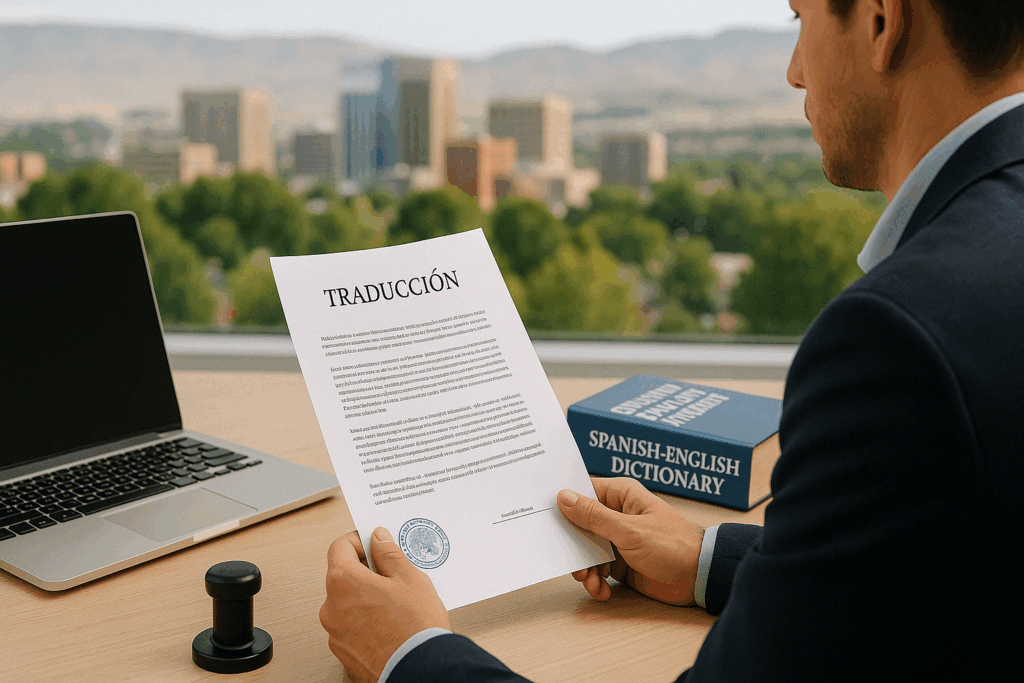
A certified translation is the full document, translated word for word, with a signed statement from the translator saying it’s complete and accurate and that they’re competent to do it. Seals, stamps, and handwriting on the original get translated too. That’s what USCIS asks for. That’s what the Idaho courts ask for.
It’s delivered as a PDF. USCIS accepts the digital copy. You don’t need a paper original for that.
Two things it isn’t:
- It isn’t notarized by default. Some Idaho state offices and a few foreign consulates want the translator’s signature notarized. I’m a notary, so if your office wants that, it’s one more step, not a second vendor.
- It isn’t a sworn translation. Spain, Mexico, Colombia, and a few other countries want the translation done by a translator their own government appointed. That’s this page.
If you’re not sure which one your office wants, send me what they told you and I’ll read it with you.
The one thing that gets Spanish translations rejected
Names. Not grammar.
A Mexican birth certificate with “Ma. del Carmen” on it, a passport that says “María del Carmen,” and a green-card application that says “Maria Carmen” is three different people to a computer. Before I place the order I ask you for the exact English spelling of every name on the document, the way it appears on the ID you’ll be filing with. Thirty seconds up front saves a rejection letter three weeks later.
How it works
- Send me the document. Text a clear photo to (208) 826-1210, or use the quote form. Tell me where it’s going (USCIS, a court, a school, a consulate) and when you need it.
- I confirm the page count and the price. Same business day, usually within a couple of hours. You pay, and the translation goes into production.
- You get the certified PDF. Most one-to-four-page documents are back in two to four business days. If it needs notarizing or an Idaho apostille after that, I do both.
Questions people ask me about Spanish translations
Can you translate my Mexican birth certificate for USCIS?
Yes. That’s the single most common Spanish job I do. The certified translation is accepted by USCIS as a digital PDF, and I’ll check that every stamp and marginal note on the acta got translated, because USCIS wants the whole page.
Is this a Spanish translation or an English one?
Either direction. Spanish to English for anything filed in the United States. English to Spanish for anything going to a Spanish-speaking country. If the destination is Spain or Mexico and it’s an official filing, ask me about a sworn translation first.
Do you do the translation yourself?
No. I’m a notary, not a translator. I use certified translators and I manage the job so you’re dealing with one person. That’s the honest answer, and it’s how nearly every certified translation service works.
Do I need it notarized?
Not for USCIS. Some Idaho agencies and some consulates do want it. Tell me who’s receiving it and I’ll tell you.
How fast?
Two to four business days for one to four pages. Rush is available. If you have a court date or an RFE deadline, say so when you send it and I’ll build around it.
Do you handle other languages?
Yes, more than 150. Spanish is just the one I see most. All languages are on the main translation page.
Send it over
Text a photo of the document to (208) 826-1210 or use the quote form. You’ll have a price the same day.
Just as a friendly reminder, I am not an attorney licensed to practice law in this state. I am not allowed to draft legal records, give advice on legal matters, including immigration, or charge a fee for those activities.
Jim Allen
Mobile Notary Since 2018
Call/Text: (208) 826-1210
Email: hello@idahonotarysigningagent.com